

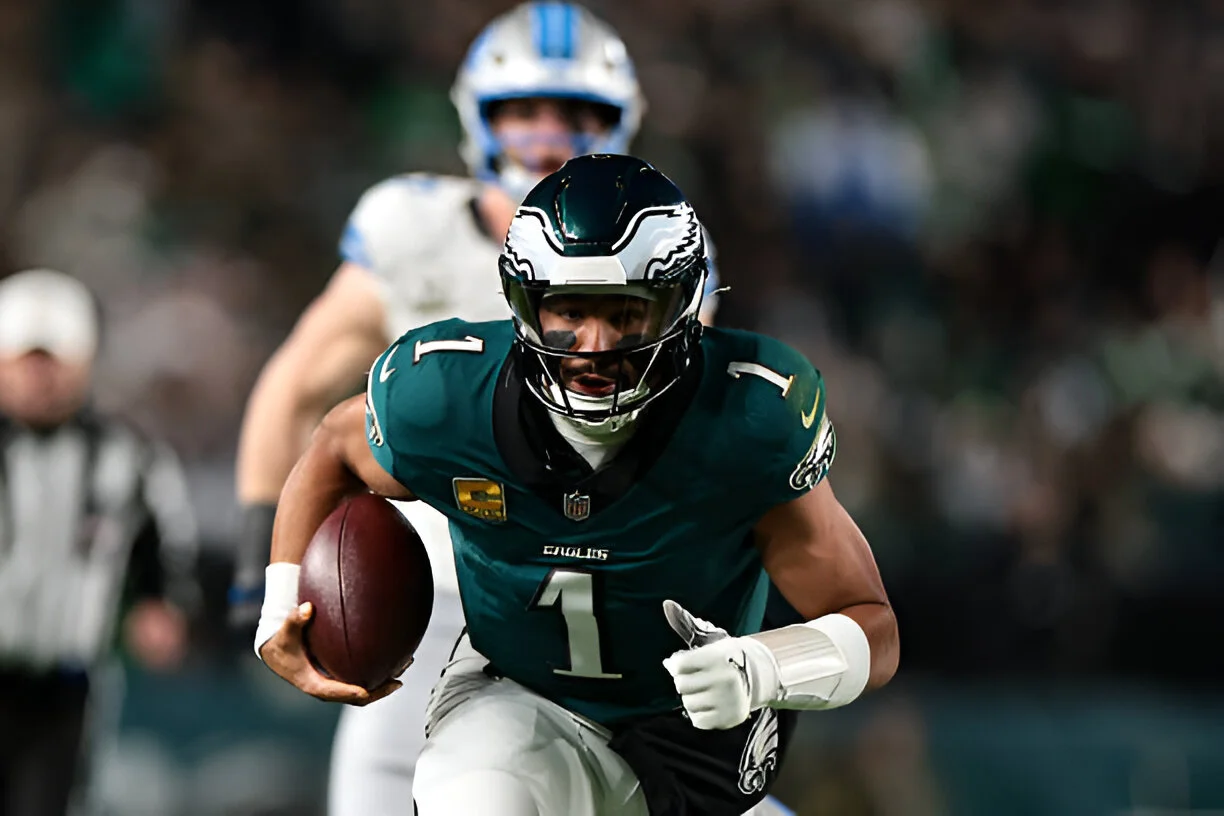

The Philadelphia Eagles have been winning, but harmony hasn’t been guaranteed. And this week, a former player lobbed a pointed critique straight at the franchise quarterback. On Sports Radio 94 WIP, ex-fullback Jon Ritchie didn’t dance around his frustrations. He suggested that beneath the calm exterior of Jalen Hurts, there may be a widening disconnect between the quarterback and the very players he relies on.
Ritchie framed Hurts as a calculated, risk-averse operator who appears to value ball security more than trust-based aggression. But he didn’t stop there. He also questioned whether Hurts’ leadership style and communication shortcomings are hindering the offense’s chemistry, even hinting that some players may be turning inward instead of toward each other.
Former Eagles Fullback Jon Ritchie Takes Jab at Jalen Hurts & Delivers Advice
Ritchie’s (who has been with the Eagles in 2003 and 04 after playing five years with the Oakland Raiders) critique began with what he believes Hurts lacks. The easy, disarming presence Donovan McNabb once brought to the building. “He was such a good guy, like a funny guy… who could use humor to his benefit,” Ritchie said, describing how McNabb lightened tense moments and built trust behind the scenes.
Donovan McNabb was the Eagles’ longtime franchise quarterback from 1999 to 2009, a six-time Pro Bowler who led Philadelphia to five NFC Championship Games and a Super Bowl appearance. Known for his easy personality and strong communication with teammates, he became one of the most influential players in modern Eagles history.
So, that became the contrast point. In Ritchie’s eyes, Hurts is “so calculated and it’s disgusting at times,” a quarterback who will throw a 50-50 ball out of bounds more often than he’ll give his playmakers a chance, unless the game situation forces aggression.
To Ritchie, that consistency isn’t just a stylistic trait; it risks alienating teammates. “I understand how his teammates could be miffed with the fact that it’s like, man, I just never have a chance if it’s even close,” he said. That’s where his larger point landed: Hurts must do a better job communicating why he plays this way, not just executing it. Ritchie believes receivers need clarity. And What Hurts wants, when he’ll take chances, what “winning leverage” looks like to him. Without those conversations, he claims, subtle resentment can grow.
“This is a communication situation within this team,” Ritchie said, even going so far as to speculate that some teammates “have now sort of turned their backs on each other.” He made it clear he was reading between the lines, but the concern was real. And in his view, McNabb succeeded not just because of talent, but because he was “a great communicator… with his teammates, with the city, behind the scenes.”
Why Jon Ritchie Chose to Call Out Jalen Hurts Now?
Here are some of the reasons why Richie said so.
The offense’s efficiency has dipped across key metrics
The Eagles’ passing game simply isn’t stretching the field the way it used to, and the numbers make that impossible to ignore. Philadelphia has ranked near the bottom of the league in multiple explosiveness categories, including a pass rate of just 1.7%, the worst in the NFL during the early stretch of the season.
At one point in the 2025 season, they sat 31st in passing offense and produced only 119 passing yards per game, according to league data. Their yards per play also cratered to 4.32, another bottom-tier figure. Even on a per-attempt basis, the passing attack has leveled out at 7.4 yards per attempt, far from their peak years when the deep-ball threat was a weekly storyline.
Receiver usage isn’t lining up with their talent level
Despite having multiple high-end pass catchers, the team’s share of contested-catch attempts and deep-shot frequency remains lower than what most offenses with elite weapons generate. That gap fuels the perception that Hurts’ caution is leaving plays on the field.
Third-down and red-zone production has cooled off
When the offense stalls in these high-leverage situations, analysts immediately examine quarterback aggression, decision timing, and trust in the playmakers. It was exactly the area Ritchie put under the microscope.
Ball-security vs. aggression is becoming an imbalance
Hurts has kept turnover numbers low, but their explosive pass percentage hasn’t kept pace. When defenses start daring you to push the ball and you don’t, former players see it as a leadership and communication issue, not just a schematic one.
Former players speak up when trends indicate strain. Ritchie knows what a cohesive offense looks like. When statistical patterns point to hesitation, missed opportunities and shrinking efficiency, he interprets it as more than a slump. But he sees the early signs of a quarterback and receiving corps drifting out of sync.
So, Ritchie’s message was blunt. If Hurts wants to elevate the whole offense, leadership can’t be robotic. It has to be relational, vocal. It has to bridge gaps before they widen.
Whether his words reflect a real internal issue or a former player interpreting smoke as fire, they’ve put a spotlight exactly where Hurts didn’t need one. Yes, you caught that right… on how his teammates actually feel about playing with him.